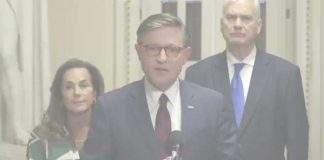
Speaker of the House Mike Johnson’s refusal to allow congressional votes on President Trump’s tariffs ignites a constitutional debate.
Story Highlights
- Mike Johnson blocks congressional votes on tariffs, citing support for Trump.
- Tariff authority is constitutionally vested in Congress, not the President.
- Bipartisan opposition emerges against Johnson’s stance.
- Supreme Court review on tariff authority adds legal complexity.
Johnson’s Refusal to Allow Tariff Votes
Mike Johnson, Speaker of the House, declared he would prevent Congress from voting on President Trump’s tariffs, even after a rule blocking tariff resolutions expires on January 31, 2026. Johnson asserts his support for Trump’s tariff measures, despite the fact that tariff authority is constitutionally granted to Congress under Article I, not the executive branch as Johnson claims. This has sparked a significant debate over the separation of powers and the role of Congress in trade policy.
This controversial decision by Johnson has led to an immediate pushback from both sides of the political aisle. Critics within the Republican Party, alongside Democrats, argue that this move undermines congressional authority and sets a dangerous precedent for executive overreach. The expiration of the House rule on January 31 presents a critical juncture for Congress to reassert its constitutional prerogatives.
Constitutional and Political Ramifications
The constitutional implications of Johnson’s stance are profound. His claim of “Article II tariff authority” is factually incorrect, as the power to impose tariffs is located in Article I of the Constitution. This misrepresentation indicates a broader issue of constitutional literacy and respect for the established separation of powers. Moreover, the ongoing Supreme Court review of Trump’s use of emergency powers for tariff implementation further complicates the political landscape, with a ruling expected to potentially reshape the legal framework around executive tariff authority.
The Republican Party faces internal divisions over Johnson’s approach. Prominent GOP figures, concerned about the erosion of legislative power, have voiced their opposition. These internal disagreements could weaken party unity on other legislative matters, reflecting an ongoing struggle between Trump loyalists and institutional conservatives.
Impact on Trade and Economy
The economic implications of continued tariffs without congressional oversight are significant. Critics argue that tariffs could exacerbate economic challenges, affecting various sectors such as agriculture, manufacturing, and retail. The uncertainty surrounding trade policy also poses risks to U.S. exporters and importers, with potential retaliatory measures from international partners like European countries, which are directly impacted by the Greenland-related tariffs.
As the deadline approaches, and with the Supreme Court’s decision pending, the outcome of this power struggle will set an important precedent for the balance of power between the legislative and executive branches. It will also determine the future landscape of U.S. trade policy, highlighting the need for Congress to play a decisive role in such critical economic decisions.
Sources:
Politico: Trump Greenland Tariffs and Congressional Response
Reason Magazine: Mike Johnson Tariff Statements Analysis
Spotlight PA: GOP Divisions on Tariff Authority
Congress.gov: Overview of S.J.Res.49