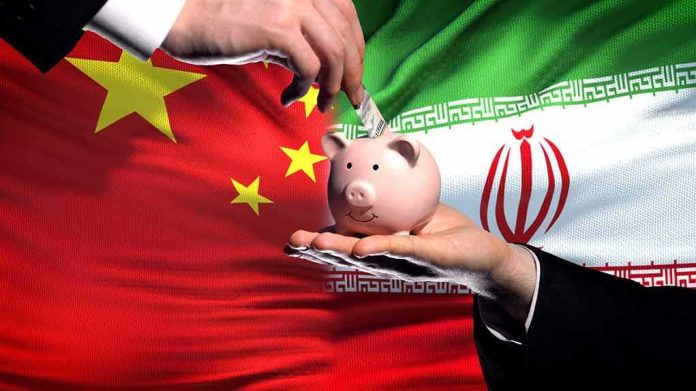
China’s oil purchases are sending Iran tens of billions of dollars each year, softening sanctions and reshaping a hot war economy.
Story Highlights
- China is Iran’s largest trading partner and buys the vast share of Iranian oil.
- A 25-year cooperation plan frames long-term energy and infrastructure ties.
- U.S. reporting links Chinese banks and front firms to sanction evasion networks.
- Opaque trade channels make specific transactions hard to verify in public data.
China’s Oil Purchases Keep Iran’s Revenues Flowing
United States government reporting says China is Iran’s largest trading partner and primary oil buyer. Analysts say Chinese purchases make up roughly 90 percent of Iran’s oil exports, delivering tens of billions of dollars a year that feed Iran’s budget and security forces. Radio Free Europe and Radio Liberty likewise reports that more than 80 percent of Iran’s oil exports go to China, underscoring how crude sales anchor the relationship and blunt sanctions pressure.
Trade often moves through indirect paths. Reports describe “shadow fleets,” ship-to-ship transfers, and discounted barrels that change hands before reaching Chinese refiners. These methods make the flows hard for outsiders to track in real time. Still, the macro picture is clear: China keeps buying, and Iran keeps earning. That steady demand has helped Tehran pay salaries, import key goods, and fund defense and proxy forces, even as Western penalties remain in place.
The 25-Year Cooperation Blueprint Sets the Frame
Iran and China signed a long-term cooperation plan that outlines closer ties in energy, finance, transport, and tech. Public reporting places the plan’s headline value near four hundred billion dollars over twenty-five years, tied to a reliable supply of Iranian oil at discounted prices. China’s foreign ministry statements and subsequent coverage describe staged collaboration as the agreement comes into force, with projects focused on oil, infrastructure, and connectivity when conditions allow.
Experts caution that many promised investments have been slow or uneven. Sanctions, banking risks, and Iran’s own politics have delayed big checks from landing. Analysts say China has sometimes shifted from large cash commitments to advising, standards, and equipment sales, especially in communications and surveillance fields. Even so, the plan still signals intent: stable oil flows to China in exchange for technology, services, and selective capital tied to approved projects over time.
Sanctions Evasion Patterns and the Evidence Gap
United States institutions describe a well-worn sanctions evasion playbook. They cite Chinese banks, intermediary firms, and front companies that help process oil trades, move money, and source dual-use goods for Iran. They also describe shipping networks that hide origin and destination details to avoid seizure or insurance problems. Independent outlets add that barter, off-book pricing, and layered firms create fog that blocks simple, public tracing of each cargo or payment.
Institute for the Study of War: Iran Update Special Report, July 29, 2026
Key Takeaways
The Iranian regime likely launched a “surprise attack” on US forces in Jordan on July 28 to erode the United States’ willingness to undermine the regime’s efforts to achieve its war aims,…
— Alex 🇺🇸 (@A_L_E_X_V_E_G_A) July 30, 2026
This gap between big-picture patterns and transaction-level proof is common in sanctions cases. The macro trends are visible in customs data, refinery runs, and Iran’s budget math. The micro deals are hard to pin down because they are designed to be hidden. That tension fuels debate in Washington and beyond. Hawks point to the money keeping Tehran afloat. Skeptics note the lack of clean, public paper trails for each shipment and component. Both things can be true at once.
What It Means for Americans Across the Aisle
For conservatives worried about national security and high energy costs, China’s role looks like a pressure valve for Tehran. Cheap Iranian barrels to Asia can tighten options for U.S. sanctions and keep Middle East risks high. For liberals focused on human rights and the costs of war, Chinese demand reduces leverage to curb Iran’s crackdowns and regional armed groups. In both views, a foreign power profits while U.S. policy tools lose bite, deepening mistrust in Washington’s ability to deliver.
Policy choices now face hard trade-offs. Stronger enforcement could target shipping, insurers, and lenders linked to disguised oil flows. But tougher moves risk higher global prices and fresh strain with Beijing. Looser pressure might calm markets but would leave Iran with steady cash. Voters see a pattern they dislike: complex deals, opaque networks, and great-power bargaining that seem far from kitchen-table needs. That gap fuels a shared belief that the system serves insiders first, not the public.
What to Watch Next
Watch for new U.S. designations on ships, brokers, and banks tied to Iranian crude. Track refinery intake data in China for signs of rising or falling Iranian barrels. Look for whether promised China–Iran projects actually break ground or stall again. Follow any back-channel talks that trade modest relief for limits on Iran’s nuclear or missile work. Each shift will signal whether sanctions regain force—or whether workarounds keep winning on the high seas.
Sources:
reason.com, uscc.gov, en.wikipedia.org, oilprice.com, rferl.org, finance.yahoo.com, thehindu.com