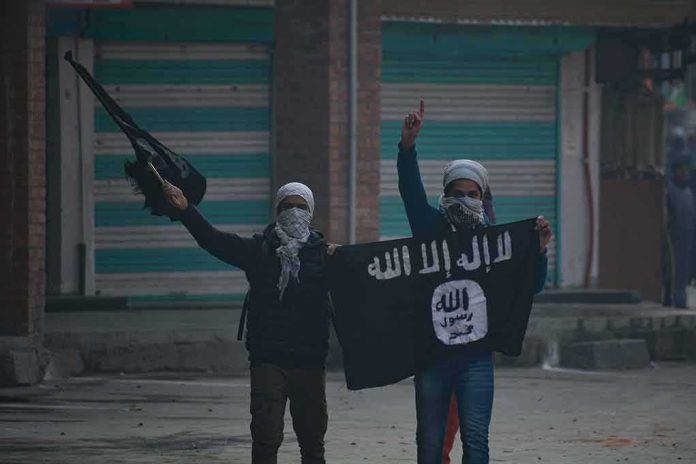
An ISIS resurgence in Syria is gaining steam, exploiting the chaotic aftermath of Assad’s collapse and a reduced U.S. military presence—raising alarm about renewed terror threats and security vacuums that history warns us never to ignore.
Story Snapshot
- ISIS has staged 117 attacks in northeast Syria through August 2025—a 60% increase over 2024.
- The group is exploiting security gaps left by the Assad regime’s fall and the reduction of U.S. forces.
- Current ISIS activity centers on insurgency tactics rather than territorial control, fueling instability.
- Regional and global security are at risk if the group reconstitutes its capacity for external attacks.
ISIS Exploits Security Vacuum After Assad’s Collapse
Following the overthrow of the Assad regime in late 2024 by Hayat Tahrir al-Sham, Syria’s security landscape has been fundamentally altered. The disappearance of centralized authority has left vast ungoverned areas, which ISIS is now exploiting to rearm, recruit, and escalate attacks. With the U.S. reducing its military footprint in the region, counterterrorism pressure has diminished, creating the very conditions that allowed ISIS to rise in 2014. The situation is reminiscent of the mistakes of the past, when American withdrawal enabled terror groups to flourish and threaten Western interests.
ISIS Intensifies Insurgent Attacks and Recruitment
ISIS has shifted its strategy from conventional warfare to insurgency, relying on sleeper cells, targeted assassinations, suicide bombings, and ambushes. Through August 2025, militants staged 117 attacks in northeast Syria—a dramatic 60% increase compared to 73 attacks in all of 2024. The group’s ability to raid unsecured arms depots after the Assad collapse has significantly upgraded its arsenal and operational capacity. High-profile attacks, such as the June 2025 church bombing in Damascus that killed 22 and wounded over 60, showcase ISIS’s persistent ability to inflict mass casualties and sow fear among civilian populations.
Regional Security Forces Struggle to Contain Threat
The Syrian Democratic Forces (SDF), comprised mainly of Kurdish fighters, continue to lead counterterrorism efforts, successfully repelling attacks and maintaining detention centers for thousands of suspected ISIS members and their families. On May 20, 2025, the SDF foiled two ISIS attacks in Deir ez-Zor and Hasakah provinces. Iraqi security forces also remain active, conducting airstrikes and ground operations against ISIS hideouts, such as the May 19 airstrike in Salahaddin province that killed two militants. Damascus-affiliated intelligence services have targeted ISIS cells in operations like the May 18 raid in Aleppo, but the sheer scale of the threat and fragmented governance impede effective action.
Governance Gaps and Humanitarian Consequences
Syria’s interim government, led by HTS, faces daunting challenges in establishing legitimacy and consolidating control. The government’s terrorist designation by international bodies blocks foreign aid and cooperation, undermining its ability to coordinate counterterrorism operations. Meanwhile, humanitarian crises persist, with thousands detained in SDF-run camps and no clear judicial processes or repatriation mechanisms in place. These conditions risk breeding further extremism, as overcrowded camps can become incubators for radicalization. The lack of rule-of-law and accountability mechanisms further complicates efforts to stabilize the region and address atrocities committed during years of conflict.
Global Ramifications and the Need for Vigilance
The resurgence of ISIS in Syria threatens not only local populations but also the broader region and Western interests. If ISIS consolidates its insurgent operations and regains territorial control in ungoverned spaces, the world could face a repeat of the devastating campaigns witnessed in 2014-2015. The terrorist group’s historical focus on external operations means a safe haven in Syria could enable the planning and execution of attacks abroad. Ongoing instability also blocks reconstruction efforts, discourages foreign investment, and prevents refugees from returning home. America and its allies must recognize the dangers of withdrawal and under-resourced counterterrorism strategies, lest constitutional freedoms and national security be sacrificed once again on the altar of globalist shortsightedness.
Sources:
Timeline: Islamic State’s Attempts to Regain Power After Being Pushed Out of Syria
Timeline: Islamic State’s Attempts to Regain Power After Being Pushed Out of Syria