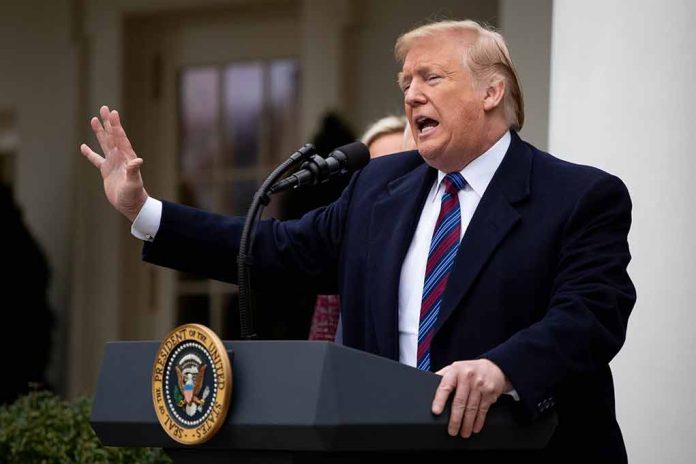
President Trump signed an executive order establishing English as America’s official language for the first time in history, balancing national unity with continued multilingual services.
Key Takeaways
- For the first time, English has been designated as the official language of the United States through an executive order signed by President Trump.
- The order rescinds Executive Order 13166 from former President Clinton that mandated language assistance for non-English speakers.
- Government agencies will still be permitted to provide documents and services in languages other than English.
- The policy aims to promote national unity, streamline government operations, and encourage immigrants to learn English.
- Previous congressional attempts to establish English as the official language have failed, though many states have already enacted similar policies.
Historic Executive Order Establishes English as America’s Official Language
President Trump has signed an executive order designating English as the official language of the United States, marking a significant shift in federal policy. While English has been the predominant language throughout American history and is featured in all founding documents, the United States has never before had an officially designated language at the federal level. The March 1, 2025 order cites the historical prominence of English in American culture and governance, noting its role in the nation’s foundational texts and its position as the common language that has united Americans across generations.
The executive order revokes a Clinton-era mandate that required federal agencies to provide language assistance services to individuals with limited English proficiency. That directive, Executive Order 13166, had been in place since 2000. Trump’s new policy shifts the focus toward encouraging English language acquisition while still maintaining flexibility for government agencies to provide multilingual services where deemed necessary. The administration has positioned this move as a means of fostering national unity and creating more efficient government operations.
Balancing National Identity with Continued Services
Despite establishing English as the official language, the order explicitly states that federal agencies may continue providing documents and services in other languages. This provision creates a balance between promoting a unified national language and ensuring government services remain accessible to all Americans. The order does not eliminate existing multilingual services but rather emphasizes the importance of English as the common tongue that binds the nation together. This approach acknowledges America’s linguistic diversity while providing a framework for cohesive national communication.
“We have languages coming into our country,” Trump stated on the campaign trail, adding, “These are languages — it’s the craziest thing — they have languages that nobody in this country has ever heard of. It’s a very horrible thing.” – Source
The administration has framed the policy as an effort to “promote unity, establish efficiency in the government, and provide a pathway to civic engagement.” By establishing a shared official language, proponents argue that new Americans will be encouraged to learn English, helping them to integrate more fully into society and access greater economic opportunities. Critics have expressed concerns about accessibility issues for non-English speakers, though the order’s provisions for continued multilingual services may address some of these concerns.
Historical Context and State Precedents
This executive action comes after numerous unsuccessful attempts by Republican lawmakers to pass legislation that would designate English as the official language. Despite these federal failures, many states have already taken similar action, with a majority of U.S. states having established English as their official language through various legislative means. The executive order represents a significant victory for advocates who have long pushed for such recognition at the federal level, seeing it as an important symbol of national identity.
The Attorney General has been tasked with updating guidance to ensure consistency with the new order across federal departments and agencies. Importantly, the executive order specifies that it does not affect existing legal authorities or create enforceable rights against the United States government. This limitation means that while the order establishes an important policy position, its practical effects may be somewhat constrained by existing laws and individual agency implementations.
Sources:
- Trump signs executive order designating English the official language of the U.S.
- Designating English as the Official Language of The United States