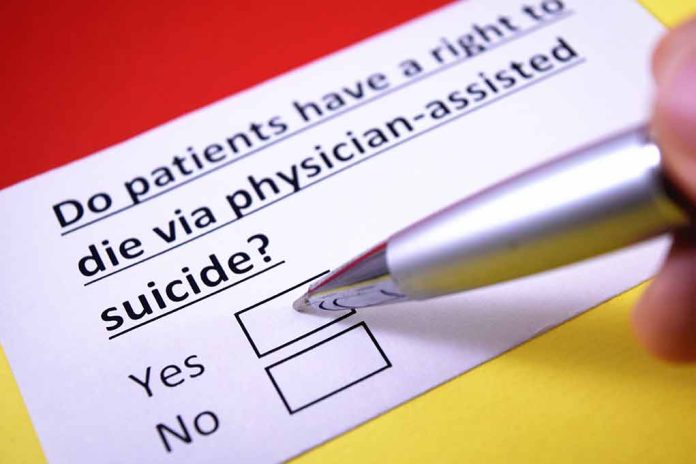
New York’s Assembly has passed a controversial assisted suicide bill allowing terminally ill patients to end their lives, sparking fierce ethical debates and raising concerns about potential future expansion of such programs.
Key Takeaways
- The New York State Assembly passed the “Medical Aid in Dying Act” with an 81-67 vote, allowing mentally competent adults with terminal diagnoses of six months or less to request life-ending medication.
- The bill faces significant opposition from religious groups, disability advocates, and over 20 Democrats who voted against it.
- Critics point to Canada’s assisted suicide program as a warning, where eligibility has expanded beyond terminal illness to include various conditions.
- The bill now moves to the State Senate where its fate remains uncertain, while Governor Hochul’s stance is unclear.
- This marks the first time such legislation has passed in either New York legislative chamber after a decade of growing support.
Assembly Approves Controversial End-of-Life Legislation
The New York State Assembly has voted 81-67 to approve the “Medical Aid in Dying Act,” marking a significant step toward legalizing physician-assisted suicide in the state. The legislation would allow mentally competent adults diagnosed with a terminal illness and given six months or less to live to request a lethal drug cocktail to end their lives. This landmark vote represents the first time such a measure has passed in either legislative chamber after gaining traction in Albany over the past decade.
The bill was sponsored by Assemblywoman Amy Paulin, who cited her personal experience watching her sister die from ovarian cancer as motivation for the legislation. While supporters argue the bill provides a compassionate option for terminally ill individuals to die with dignity, the measure faced substantial opposition, including approximately 20 Democrats who joined Republicans in voting against it.
“Each and every life has value,” stated Assemblywoman Mary Beth Walsh during the debate, articulating the fundamental concern of many opponents.
Opposition and Ethical Concerns Mount
Opposition to the bill comes from diverse quarters, including religious organizations, disability rights advocates, and medical professionals who believe resources should be directed toward improving palliative care rather than facilitating death. Critics have raised significant concerns about potential pressure on vulnerable populations and the message such legislation sends about the value of life, particularly for those with disabilities or terminal conditions.
“I watched my mom die. I watched my daughter die. And I know that for a fact that none of us are getting out of here alive. At some point or the other, we’re all going to go, but I don’t believe there should be a combination of six drugs offered to someone to end their life,” expressed Assembly Majority Leader Crystal Peoples-Stokes, highlighting the personal and ethical dimensions of the debate.
Those opposed to the legislation point to Canada’s Medical Assistance in Dying (MAID) program as a cautionary example. Initially restricted to terminally ill and mentally competent individuals, Canada’s program has gradually expanded to include various non-terminal conditions. Reports have emerged of individuals seeking help for depression being offered assisted suicide due to healthcare resource limitations, raising alarms about potential similar developments in New York.
Uncertain Future in the Senate
The bill now moves to the State Senate, where a similar measure failed last year. State Senate Majority Leader Andrea Stewart-Cousins has acknowledged growing support for the proposal but stopped short of committing to a floor vote. “The conversation had begun in earnest last year. So I think we have time to look at it seriously,” Stewart-Cousins stated, indicating the measure would receive careful consideration.
Governor Kathy Hochul’s position on the legislation remains unclear, adding another layer of uncertainty to the bill’s prospects. If passed, New York would join ten other states and Washington D.C. that have already legalized some form of assisted suicide. Advocates maintain such measures provide compassionate options for those suffering terminal illnesses, while opponents continue to emphasize concerns about potential expansion beyond the bill’s current limitations.
Sources:
- NY state Assembly passes controversial assisted suicide bill after 5 hours of emotional debate
- New York Just Took a Big Step Toward State-Sponsored Suicide