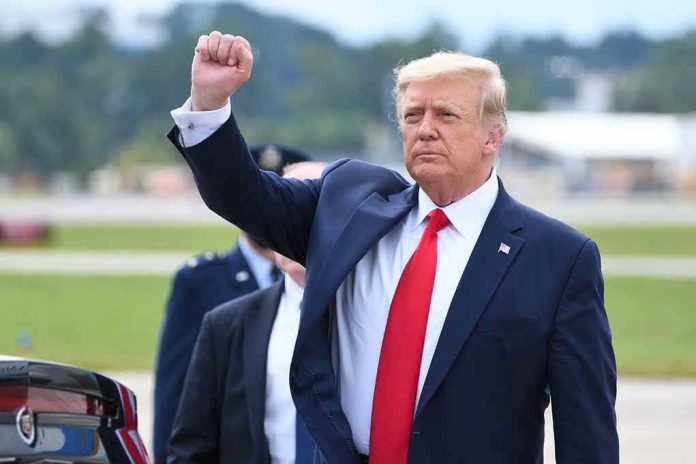
At a packed Pennsylvania rally, President Trump stunned the political class by hailing Treasury Secretary Scott Bessent as “our savior” in the fight to rescue America’s economy from Biden-era damage.
Story Snapshot
- Trump praised Treasury Secretary Scott Bessent as “our savior” during a Mount Pocono, Pennsylvania rally, drawing loud approval from supporters.
- The remark underscored how central economic recovery is to Trump’s second-term agenda after years of inflation, overspending, and regulatory overreach.
- Trump framed Bessent’s role as reversing Biden-era fiscal mismanagement while restoring growth, jobs, and stable prices for working families.
- The Pennsylvania setting highlighted Trump’s focus on blue-collar voters who bore the brunt of inflation, high energy costs, and open-borders policies.
Trump’s Pennsylvania Rally Puts Economic Rescue Front and Center
President Donald Trump used his Mount Pocono, Pennsylvania rally to highlight economic recovery as the defining mission of his second term, singling out Treasury Secretary Scott Bessent as “our savior” to thunderous applause. The remark was not a casual compliment but a deliberate signal that, in Trump’s view, the Treasury will be the spearhead for undoing years of fiscal excess, inflation, and regulatory burdens that hammered savers, retirees, and working families under the previous administration.
Trump’s language connected with a crowd that lived through soaring grocery prices, shrinking retirement accounts, and higher borrowing costs after years of Washington’s addiction to spending. By praising Bessent in such dramatic terms, Trump placed clear responsibility on his Treasury team to stabilize the dollar, tame inflation, and restore confidence similar to the gains many conservatives remember from his first term’s tax cuts, deregulation, and record job creation before the pandemic-era disruptions.
From Biden-Era Inflation to a Mandate for Course Correction
Voters in Pennsylvania’s working-class communities endured the fallout of Washington’s overspending and regulatory expansion, watching paychecks stretched thin by higher prices at the pump, the store, and on utility bills. Trump framed Bessent’s mission as correcting this course by prioritizing sound money, restrained federal spending, and pro-growth tax and regulatory policies. For conservative voters, the “our savior” line captured a sense of urgency about reversing policies they see as punishing work, savings, and American energy production.
Trump’s supporters view the Treasury as a frontline defense against renewed attempts to use financial regulation and spending programs to advance left-wing priorities. They worry about efforts to direct credit away from domestic energy, saddle small businesses with ESG-style mandates, or quietly normalize permanent deficit levels that weaken the dollar and threaten retirement security. By elevating Bessent in such strong terms, Trump reassured his base that economic leadership would resist these pressures and instead focus on rebuilding prosperity rooted in private enterprise and limited government.
Why Conservatives See the Treasury Role as Bigger Than Wall Street
Conservative voters increasingly understand that Treasury decisions reach far beyond Wall Street and directly shape everyday life, from mortgage rates and car loans to pension stability and small-business credit. Under a Republican vision, Treasury stewardship is expected to favor domestic production, fair trade, energy independence, and a tax climate that rewards work and investment. Trump’s rally rhetoric suggested that Bessent is tasked with aligning federal financial policy with these priorities rather than accommodating international institutions or climate-focused bureaucrats.
Many in Trump’s audience remained wary of the globalist mindset that dominated Washington for decades, where financial policy often catered to multinational interests, green activists, and unelected regulators instead of American workers. Trump’s praise of Bessent served as a promise that his Treasury would prioritize the strength of the U.S. economy, the dollar, and American industry over foreign approval or ideology. For conservatives, that means defending domestic energy jobs, reducing regulatory drag on small businesses, and resisting pressures to adopt policies that effectively tax or ration everyday energy use.
Pennsylvania as a Symbol of Blue-Collar Recovery and Constitutional Priorities
Holding the rally in Mount Pocono underscored Trump’s ongoing focus on swing-state, blue-collar voters who powered his earlier victories and suffered disproportionately during the inflationary years. Many attendees link border chaos, federal spending spikes, and regulatory expansion to stagnant real wages and declining community stability. By spotlighting Bessent there, Trump tied economic policy to broader conservative themes: secure borders, law and order, energy independence, and an economy that rewards families who play by the rules.
For a conservative audience already frustrated by government overreach, Trump’s description of Bessent as “our savior” functions as shorthand for a larger promise: that Washington will stop using economic policy to engineer social outcomes and instead return to constitutional limits, free markets, and American sovereignty. Whether Bessent ultimately meets those expectations will depend on how aggressively the administration reins in spending, resists politicized regulation, and restores the conditions for real wage growth and stable prices that working families demand.
Sources:
Trump Calls Treasury Secretary Scott Bessent ‘Our Savior’ at Pennsylvania Rally