
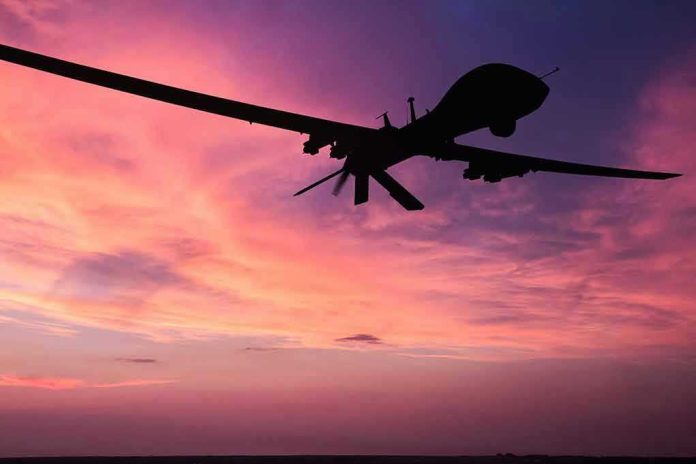
A new DHS office dedicated to counter-drone technologies aims to strengthen national security, but raises privacy concerns among civil liberties advocates.
Story Overview
- DHS launches new office to oversee drone and counter-drone technologies.
- $115 million investment to secure 2026 World Cup and America’s 250th anniversary events.
- Concerns arise over potential privacy intrusions and constitutional issues.
- Trump administration expands federal authority for drone tracking until 2031.
DHS Establishes New Office for Drone Technologies
The Department of Homeland Security (DHS) announced the launch of the Program Executive Office for Unmanned Aircraft Systems (UAS) and Counter-UAS on January 12, 2026. This office aims to oversee investments in drone deployment and counter-drone technologies in response to rising security threats. The office is set to finalize a $115 million investment to secure major events in 2026, such as the FIFA World Cup and America’s 250th anniversary celebrations.
With the creation of this office, DHS emphasizes the need to maintain “air superiority” to counter nefarious drone activities that threaten national security. This initiative builds upon previous ad-hoc efforts, providing strategic oversight and utilizing extended federal authority, which has been granted until 2031 under the FY26 National Defense Authorization Act (NDAA), signed by President Trump in December 2025.
Security vs. Privacy Concerns
While the DHS’s new office aims to bolster security for high-profile events, it raises significant privacy concerns. Advocacy groups, including the ACLU, express worries about potential overreach and intrusion into civil liberties. Georgetown Law Professor Laura Donohue highlights troubling constitutional issues, advocating for warrant requirements and boundaries on data access and mitigation.
This move comes amid a backdrop of increased drone sightings near sensitive areas, including airports and stadiums. Reports indicate over 100 monthly unauthorized drone sightings near airports and approximately 2,300 incidents at NFL stadiums since the NDAA extension. These incidents underscore the need for enhanced drone countermeasures to protect public safety.
Economic and Political Implications
The establishment of the Program Executive Office for UAS and Counter-UAS not only promises to enhance security but also has significant economic implications. The Trump administration has allocated $500 million in grants to support state and local anti-drone efforts, with a potential $1.5 billion in contracts for industry partners. This investment is expected to spur innovation and adoption of counter-drone technologies, fostering growth in the sector.
Politically, this move strengthens the Trump administration’s security posture, particularly in combating cartel activities and threats from unauthorized drones. However, it also intensifies the debate over privacy rights and government surveillance, requiring careful consideration of the balance between national security and civil liberties.
Sources:
DHS Launches Office for Drone and Counter-Drone Technologies
DHS Adds Office to Fly, Counter Drones
DHS Drone Office for Unmanned Aircraft Systems