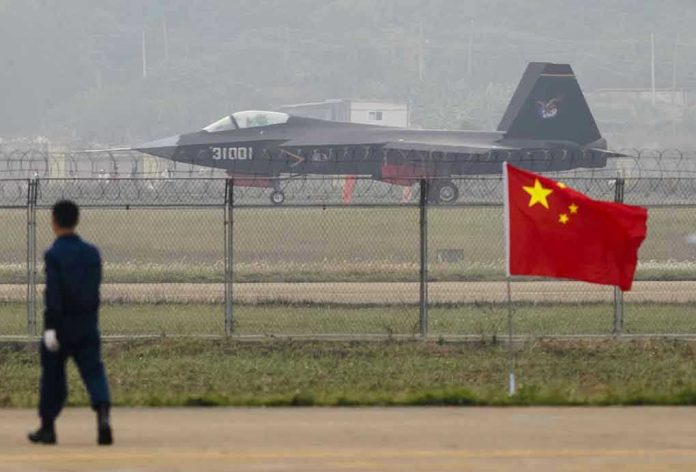
China’s J-20 ‘Mighty Dragon’ stealth fighter, boasting a Mach 2 top speed, raises skepticism about its real-world combat effectiveness.
Story Highlights
- J-20 boasts impressive specs like Mach 2+ speed and stealth features.
- Experts question its true capabilities due to unproven stealth and engine reliability.
- The fighter’s value is debated in modern networked warfare.
- China’s focus is on quantity over quality with ~300 units by 2025-2026.
China’s Ambitious Military Move
The Chengdu J-20 “Mighty Dragon” is China’s foray into fifth-generation stealth fighters, claiming speeds of Mach 2 via its diverterless supersonic inlets (DSI). Developed by Chengdu Aerospace Corporation (CAC), it aims to counter U.S. air superiority with the F-22 and F-35. Despite its striking specifications on paper, its real-world capabilities remain under scrutiny due to unresolved questions about its stealth, engine performance, and combat readiness.
The J-20, introduced to the People’s Liberation Army Air Force (PLAAF) in 2017, represents China’s drive for military modernization, especially in the South China Sea and Taiwan regions. With production ramping up, estimates suggest 300 units by 2025-2026. However, experts argue that its speed and other specifications might not translate into battlefield dominance without proven stealth and sensor fusion capabilities.
Technical Hurdles and Strategic Implications
While the J-20’s Mach 2 speed is an impressive feat, experts highlight that speed alone doesn’t determine effectiveness in modern warfare. The fighter’s stealth capabilities are questioned due to its canard-delta design, which might compromise its radar cross-section compared to the U.S. F-22. Moreover, its engine reliability remains a critical issue, with the WS-15 engines still undergoing integration to achieve full potential.
The J-20’s development reflects a strategic shift for China from quantity to quality in its air force arsenal. However, the focus on producing a large number of fighters raises questions about the trade-off between quantity and the unproven quality of these aircraft. This approach can impact regional security dynamics, prompting neighboring countries and the U.S. to reassess their military strategies.
Global Reactions and Future Outlook
Globally, the J-20’s advancements have sparked a mixed reaction. On one hand, it represents a significant leap in China’s military capabilities, potentially challenging U.S. air superiority. On the other hand, skepticism about its real-world effectiveness persists. The lack of combat experience, unlike U.S. fighters like the F-22, adds to the uncertainty about its operational value.
As China continues to expand its J-20 fleet, the world watches closely. The fighter’s role in potential future conflicts and its impact on global military balances remain subjects of intense scrutiny and debate. The strategic implications of China’s military prowess will likely shape geopolitical dynamics in the years to come.
Sources:
China’s J-20 Mighty Dragon Stealth Fighter Summed Up in 1 Word
Inside China’s J-20 Revolution: 300 Stealth Fighters Challenge F-22/F-35