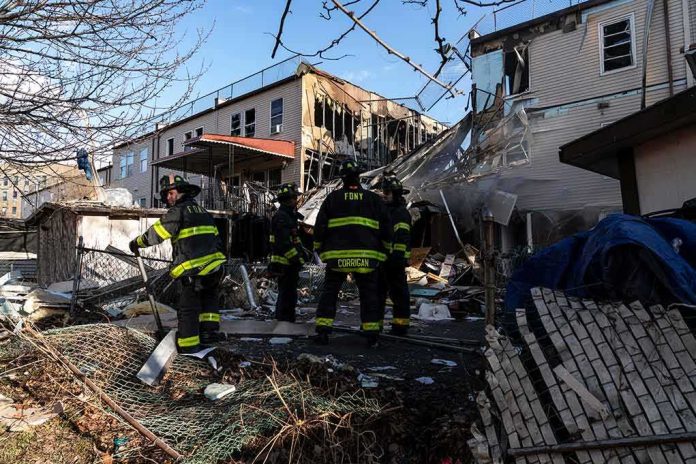
A deadly apartment blast in Brooklyn tied to a suspected lithium-ion battery shows how one device can turn public housing into a firetrap in seconds.
Story Highlights
- Officials say an 18-year-old died after an explosion and fire at NYCHA’s Albany Houses in Crown Heights.
- Firefighters responded around 7 p.m. Friday to a 12th-floor apartment at 162 Troy Avenue.
- Fire officials believe a lithium-ion battery sparked the blaze, a cause seen across New York City.
- New York City has logged hundreds of lithium battery fires in recent years, with dozens of deaths.
What Happened At The Albany Houses
New York City police and fire officials reported one death after an explosion and fire at the New York City Housing Authority Albany Houses in Crown Heights on Friday evening. Crews arrived just after 7 p.m. to a 12th-floor apartment at 162 Troy Avenue and found heavy fire conditions. Officials identified the victim as an 18-year-old. Local outlets reported dozens of fire units on scene as smoke spread through upper floors and stairwells during the response.
Fire Department leaders told reporters they believe a lithium-ion battery likely started the blaze, based on early findings at the scene. Reporters from multiple outlets described an initial explosion followed by fast-moving flames. Police confirmed the fatality and said the investigation into the exact cause remains active. Early cause assessments often precede a final fire marshal ruling, but officials say battery-driven fires have a clear pattern in recent city incidents.
Why Lithium-Ion Batteries Keep Causing Deadly Fires
Fire Department data and national fire experts have tracked a surge of lithium-ion battery fires across New York City since 2022, driven by e-bikes, e-scooters, and other devices. The National Fire Protection Association cited city figures showing more than 800 such fires and 30 deaths over that period. Batteries that are damaged, off-brand, or charged indoors can fail and erupt without warning. When they ignite near doors or stairs, escape paths can vanish in seconds.
City officials say prevention steps have helped lower deaths at times, but the total number of battery fires remains high. The Fire Department reported 277 lithium battery-related fires in 2024, roughly in line with the prior year, even as public warnings and enforcement increased. Officials also note many fires start when batteries are not charging, which makes them harder to predict or avoid with simple habits. That pushes risk onto families who have little room to store devices safely.
Public Housing, Tight Spaces, And Uneven Safety
Public housing residents often face the worst conditions when these fires strike. Crowded apartments, older building systems, and limited storage force people to keep e-bikes and scooters indoors. When a battery fails in a small unit, heat and smoke overwhelm halls and stairwells fast. In Friday’s case, the fire erupted on an upper floor, where evacuation is harder and elevators cannot be used during a fire, heightening the danger for every neighbor on that line.
For many working people, e-bikes are not a luxury. They are a job tool that cuts commute time and cost. But rules, recalls, and safe charging options have not kept pace with use. Residents see another hazard they must manage on their own. This feeds a wider belief that leaders talk about safety but leave people to face rising risks in aging buildings. When a battery disaster hits, families pay the price while agencies argue over codes, budgets, and who is responsible.
Policy Steps That Could Help Now
City leaders have pushed for certified batteries, licensed repair shops, and clearer storage rules. Those steps matter, but enforcement must reach the buildings where risk is highest. Simple actions can save lives: install more charging lockers at ground level, add fire-rated storage rooms, and expand outlet capacity so residents do not rely on risky power strips. Clear guidance in multiple languages, delivered door to door, beats a poster in a lobby.
State and city agencies can also track battery sales and press manufacturers to meet stronger standards. The Fire Department’s data show that progress is possible when policy and practice line up. The public will judge governments by results, not press events. After Crown Heights, the test is direct: make it easier for people to work and live without turning their hallway into a gasoline trail. Families in public housing deserve the same margin of safety as anyone else.
Sources:
nypost.com, cbsnews.com, abc7ny.com, nyc.gov