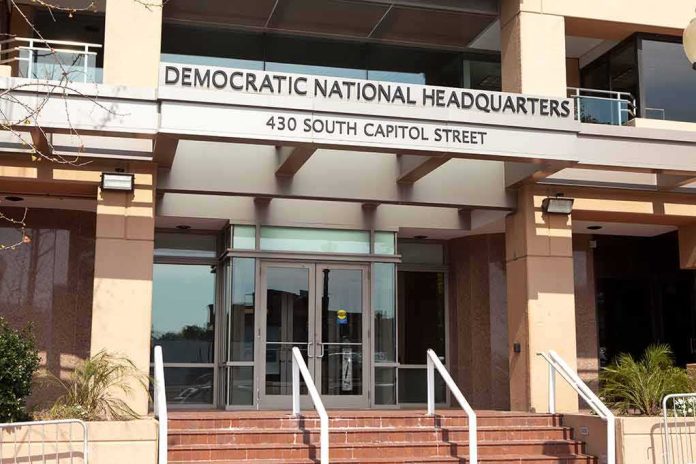
America’s main liberal party just mortgaged its own headquarters to stay afloat before the 2026 midterms — a striking sign of how shaky and debt‑driven our politics have become.
Story Snapshot
- The Democratic National Committee pledged its Washington, D.C., headquarters as collateral for a $15 million credit line.
- Federal records show the committee with about $16 million in cash but roughly $18 million in debt, leaving it in the red as the midterms near.
- Democratic officials say borrowing against the building is not new, but this is their largest off‑year loan and comes with a big Republican cash gap.
- The episode highlights how both parties lean on banks, donors, and “inside money” while many Americans feel shut out of the system.
DNC headquarters put up to secure a major loan
District of Columbia deed records show the Democratic National Committee used its headquarters at 430 South Capitol Street Southeast in Washington as collateral for a $15 million line of credit taken out in 2025. Reporters at NOTUS first detailed the move, describing how the building was pledged to help fund off‑year elections and party‑building work before the 2026 midterms. Commentators quickly seized on the story, branding the party “broke” and warning that even national committees now rely on hocking their own assets to stay in the game.
Coverage of the collateral deal builds on earlier reporting that the Democratic National Committee had already taken out $15 million in loans in October 2025 to refill its reserves after the failed 2024 Biden‑Harris campaign and to finance contests in Virginia and New Jersey. Those loans left the committee with about $18.3 million on hand, with most of that money coming from borrowed funds. Party officials framed the credit line as a way to ensure full funding for 2026 operations even as donations lagged.
BROKE Democrats Put Up DNC Headquarters as COLLATERAL for Massive $15 Million Loan Ahead of 2026 Midterms
— 🇺🇸🇨🇿🇸🇪 PENNSYLVANIA IS TRUMP™ (@RED_IN_PA) July 27, 2026
A debt‑heavy balance sheet and big gap with Republicans
Federal Election Commission data and media summaries show the Democratic National Committee heading into the 2026 midterms with more debt than cash, roughly $16 million in its accounts and about $18 million owed. That two‑million‑dollar hole might not sink a national party by itself, but it raises alarms when compared to the Republican National Committee’s position, with about $128 million in cash and no reported debt. For many voters on both sides, this looks like a political system run on loans, big donors, and insider money, not on normal citizens’ small contributions.
Reports also note that 2025 and 2026 spending has been unusually heavy, with the Democratic National Committee paying off around $18–20 million in leftover costs from the Kamala Harris 2024 campaign while still trying to fund current races. That past‑campaign debt dragged down the party’s cash totals and pushed it toward borrowing earlier and in larger amounts than in some past cycles. The result is a committee that can still operate but is more leveraged and more dependent on banks and lines of credit than many Americans might expect from the party that says it can manage the nation’s finances.
Is this a crisis or “normal” party borrowing?
Democratic officials argue the collateral move is standard practice, saying the headquarters has backed loans in 2014, 2018, 2019, and other years. They describe the 2025 facility as an off‑year credit line, not a sign of default or imminent foreclosure, and stress that access to bank financing allows them to smooth out uneven fundraising. Independent coverage supports the idea that national party committees often borrow, but it also notes that this is the largest off‑year loan the Democratic National Committee has taken and that the building pledge was not clearly spelled out in public finance filings.
For everyday Americans watching this from the outside, the argument over “routine” borrowing may feel beside the point. Both parties spend huge sums, rely on corporate and wealthy donors, and now even mortgage their own headquarters, while many families struggle with basic bills and see the American Dream slipping away. The Democratic National Committee’s debt‑heavy position and the Republican National Committee’s huge cash edge feed a shared belief across left and right that insiders and party machines play by different rules, backed by banks and dark‑money groups, while regular voters are treated mainly as spectators.
What this says about the health of the political system
The fight over whether the Democratic National Committee is “broke” highlights a larger problem: our national politics now run like a permanent high‑stakes business, with constant borrowing, massive fundraising targets, and little transparency about who really calls the shots. When a major party quietly pledges its headquarters to secure tens of millions in credit, it signals how deep the money pressures run behind every message and every ad we see. That hidden financial stress matches what many citizens already feel—that the system serves donors, consultants, and entrenched party elites more than the people it claims to represent.
Sources:
thegatewaypundit.com, nypost.com, townhall.com, redstate.com, foxnews.com, pjmedia.com, nytimes.com, wsj.com, washingtonpost.com