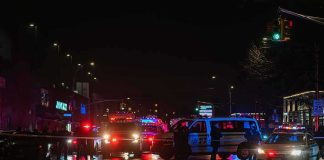
An online claim of “radioactive drones” targeting Israel’s embassy in London is colliding with a hard reality: police say no embassy attack occurred, yet multiple Iran-linked investigations are still unfolding.
Quick Take
- London counter-terror officers are investigating a social-media video by a little-known Islamist group claiming a drone attack near the Israeli Embassy, but police say no attack on the embassy has been confirmed.
- The “radioactive” angle circulating online is not supported by the core reporting cited in the research; officials have discussed “discarded items” and “dangerous substances” claims without confirming radiation.
- Separate from the online claim, UK authorities arrested Iranian nationals in operations tied to suspected plots and surveillance activity involving Jewish or Israeli-linked targets.
- The episode highlights a modern security challenge: viral threat narratives can spread faster than verified facts, even while real counter-terror cases move through the courts and intelligence channels.
Police investigate a viral claim, but confirm no embassy attack
London’s Metropolitan Police Counter Terrorism Command is examining a video posted online by a group calling itself Ashab al-Yamin, which claimed drones carrying “dangerous substances” were used in an alleged attack connected to the Israeli Embassy area. Reporting cited in the research says the footage showed masked individuals and a vehicle fire in Kensington Gardens, while police pursued “urgent inquiries” into the clip’s authenticity and possible links to items reportedly discarded in the park.
Police have also emphasized what many headline-scrollers miss: authorities have not confirmed an attack on the Israeli Embassy itself. That distinction matters for public trust. When terrifying details such as “radioactive” payloads become the lead narrative online, the public can end up reacting to the most alarming version of events rather than the verified one. In counter-terror work, premature conclusions can undermine legitimate investigations and fuel copycat panic.
What’s known, what’s not: “dangerous substances” versus “radioactive drones”
The research summary makes a key point: the sensational framing about radioactive drones and hazmat-suited police “swarming” a park does not match the verified details described in the cited reporting. Ashab al-Yamin’s claims referenced “dangerous substances,” but the material was not identified publicly as radioactive, and the group itself is described as emergent and unverified. That leaves a factual gap between a social-media allegation and what investigators can prove.
This gap is not trivial. Conservatives often warn—correctly—that institutions and media ecosystems can distort reality, whether through ideological framing or simple click incentives. In this case, the distortion can cut in the opposite direction: exaggeration that inflames fear and anger without evidentiary grounding. For citizens trying to make sense of threats, the prudent standard is straightforward—treat online “proof” as unproven until law enforcement corroborates the chain of evidence.
Separate cases raise the stakes: arrests tied to suspected Iran-linked activity
Even if the video proves to be a hoax or propaganda, UK authorities are simultaneously pursuing separate Iran-linked counter-terror matters. Reporting referenced in the research describes arrests of Iranian nationals suspected of involvement in plotting an attack connected to the Israeli Embassy in London. Officials characterized the situation as a major national security concern, and investigators have indicated the work is at an early stage, including assessing motives and any ongoing risk to the public.
Other operations described in the research involved arrests related to surveillance activity focused on Jewish community locations, under national security authorities. Searches and enforcement activity were reported across several London-area locations. These cases are significant because they point to a broader strategic problem European governments have grappled with since 2022: hostile-state or proxy activity that targets soft civilian sites, exploits open societies, and forces democracies to spend heavily on prevention rather than prosperity.
A wider pattern: UK pressure over alleged Iran-backed plots since 2022
The background in the research points to a broader trend: the UK has faced numerous suspected Iran-backed plots since 2022, often involving Israeli or Jewish-linked targets. That context is why even an unverified social-media claim can trigger serious investigative attention. London, like many major Western cities, must treat threats as potentially real until disproven, because the downside risk—an attack on a diplomatic mission or a community institution—is catastrophic.
For Americans watching from afar in 2026, the lesson is less about British politics and more about governance capacity. Public safety depends on competent institutions that can separate signal from noise, act quickly, and communicate clearly. When citizens believe government is failing—either by missing threats or policing speech instead of criminals—trust erodes. Restoring that trust requires transparency about what is confirmed, what is suspected, and what remains unverified.
The bottom line: don’t let propaganda outrun verification
Authorities are still working to determine what, if anything, the Kensington Gardens video represents beyond intimidation theater. The research indicates no confirmed embassy strike and no verified evidence for the most extreme “radioactive” claims, even as real investigations and arrests connected to Iranian nationals proceed. That combination—unverified viral claims alongside genuine counter-terror cases—is exactly how modern influence operations can succeed: by muddying the water until the public stops believing any official account.
You can instantly find a free speech violation, but can’t find terrorists! England has fallen!
Iran-Linked Terror Cell Claims Radioactive Drone Attack on Israeli Embassy in London as Police Swarm Park in Hazmat Suits https://t.co/k1pfbIMOxi #gatewaypundit via @gatewaypundit— C.J. Mohammed (@cocjmo14) April 17, 2026
Citizens do not have to choose between complacency and hysteria. A common-sense approach is to demand proof before repeating the most alarming version of a story, while still recognizing that targeted intimidation of Jewish and Israeli-linked sites is a recurring concern in Europe. Strong borders, competent intelligence, and clear public communication are not partisan luxuries—they are basic functions of a state that intends to protect ordinary people.
Sources:
Jerusalem Post — Diaspora/Antisemitism article-893366
Iran International — en/202603063499