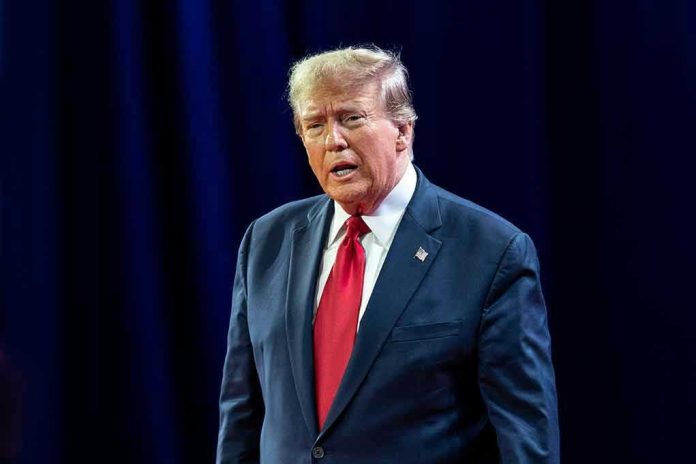
President Trump’s renewed threats to abandon NATO have exposed a shocking reality: Europe is racing to prepare for the unthinkable collapse of the world’s most powerful military alliance while Washington elites bicker over who controls American foreign policy.
Story Snapshot
- Trump’s continued NATO withdrawal threats force European allies to plan €800 billion defense buildup by 2035
- Congressional law requires two-thirds Senate approval for formal exit, but experts warn president can “hollow out” alliance through troop withdrawals
- America currently funds 62% of NATO spending while Europe lacks critical military capabilities like satellite surveillance and nuclear deterrence
- European nations scrambling to meet new 5% GDP defense spending target as Russian aggression continues
Alliance Under Unprecedented Strain
NATO faces its gravest existential crisis in 77 years as President Trump continues threatening to withdraw American support from the alliance. Unlike France’s 1966 partial departure from NATO’s military command structure, a US exit would fundamentally cripple an organization where America provides 62% of total funding and nearly all advanced military capabilities. The December 2023 National Defense Authorization Act requires two-thirds Senate approval for formal withdrawal, yet experts warn this legal barrier means little when the commander-in-chief controls troop deployments and operational commitments.
Europe Scrambles for Self-Reliance
European NATO members responded to Trump’s threats by establishing the ReArm Europe initiative, mobilizing up to €800 billion for independent defense capabilities. At NATO’s 2025 summit, member nations committed to reaching 5% of GDP in defense spending by 2035, a dramatic increase from the previous 2% target many struggled to meet. Germany, Poland, and Baltic states hosting American forces face particular vulnerability, lacking substitutes for US satellite surveillance, missile defense systems, and airlift capacity that underpin collective security against Russian aggression.
Presidential Power Versus Congressional Authority
The constitutional clash between executive and legislative authority creates dangerous uncertainty for America’s allies. While Congress enacted laws blocking unilateral presidential NATO exit, analysts including former NATO ambassador Ivo Daalder note the president can effectively “hollow out” commitments without formal withdrawal. Trump could order troop pullouts from European bases, refuse participation in joint exercises, withhold intelligence sharing, and ignore Article 5 mutual defense requests. Senator Thom Tillis warned such moves pose “enormous risk” to global American leadership, yet enforcement mechanisms for congressional restrictions remain unclear and untested.
Strategic Implications for Global Security
A functional US withdrawal from NATO would transform global security dynamics in ways beneficial to adversaries like Russia. European allies in Poland and the Baltic states would face immediate deterrence collapse without American nuclear umbrella protection and forward-deployed forces. Charles Kupchan and other defense analysts warn that Europe cannot quickly replace America’s “invisible architecture” of military enablers. The precedent would likely strain other US alliances across Asia, accelerating the shift toward a multipolar world where Washington’s security guarantees carry diminished credibility and influence.
Beyond immediate security concerns, this crisis highlights a fundamental problem frustrating Americans across the political spectrum: unelected bureaucrats and foreign policy elites making commitments that burden taxpayers while European partners failed for decades to meet basic defense spending obligations. The debate reveals legitimate questions about whether endless subsidization of wealthy European defense serves American interests, even as it exposes the recklessness of abandoning strategic positions without coherent alternatives. NATO’s founding principle of collective defense against tyranny remains sound, but the alliance’s current structure clearly fails both American taxpayers and the sovereignty concerns driving popular discontent with globalist entanglements managed by Washington’s permanent political class.
Sources:
Trump pulling out of NATO, explained – Northeastern University
Withdrawal from NATO – Wikipedia
What would happen if the US left NATO – The Week