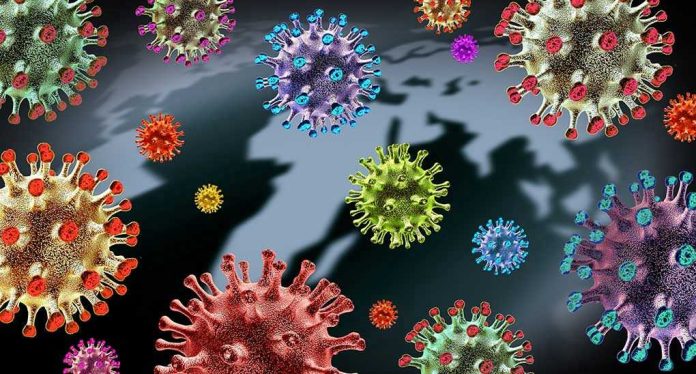
Amidst a world that once seemed fictional, concerns arise over the potential for a real-life scenario resembling ‘The Walking Dead,’ as experts debunk myths while exploring real-world pandemics and disasters.
Story Snapshot
- No real-world pathogen matches the ‘Walking Dead’ scenario.
- Experts use zombie narratives for public health education.
- Real pandemics have shown systemic fragility.
- Speculative scenarios highlight preparedness needs.
The Fictional Premise of ‘The Walking Dead’
The TV series ‘The Walking Dead,’ based on Robert Kirkman’s comic series, presents a fictional world ravaged by the Wildfire virus. This pandemic, beginning in France in April 2010, leads to a global collapse where the dead reanimate as “walkers” unless their brains are destroyed. The focus is on human behavior and survival in the post-collapse world rather than the virus’s origin.
‘The Walking Dead’ explores societal breakdown as governments and infrastructure fail, leaving survivors to navigate violence and scarcity. Unlike other zombie narratives, this series emphasizes a universal infection, aggressive decomposition, and a biomedical framing rather than supernatural elements. The narrative unravels over multiple seasons, exploring long-term societal evolution.
Real-World Analogues and Comparisons
While no real-life event mirrors the fictional Wildfire virus, various pathogens and crises offer partial analogues. Modern zombie concepts stem from Haitian folklore and were popularized by cinema, notably George A. Romero’s films. Real infections like rabies and prion diseases, alongside parasites and drug-induced episodes, have been compared to zombie-like conditions, though none cause reanimation.
Real pandemics, such as COVID-19, have highlighted systemic fragility, with zoonotic diseases like Ebola and SARS showcasing rapid transmission and health system overwhelm. Behavioral and neurological disorders have fueled speculation about brain-targeting pathogens, but these remain speculative without the cataclysmic outcomes portrayed in ‘The Walking Dead.’
Current Real-World Perspectives
No current pathogen causes post-mortem reanimation or universal infection. Fringe claims about “zombie viruses” often misrepresent scientific studies on ancient permafrost viruses, which are non-threatening to humans. Experts use zombie models as educational tools to discuss public health strategies, emphasizing the implausibility of reanimation with current knowledge.
Security analysts consider zombie scenarios as metaphors for complex disasters involving biological, infrastructural, and societal breakdowns. While experts stress the improbability of such events, they underscore the importance of preparedness, highlighting that the weakest link in any crisis is often human systems, not the pathogens themselves.
Sources:
Real-Life Events That Altered The Walking Dead
The Trials (TV Universe) – Walking Dead Wiki