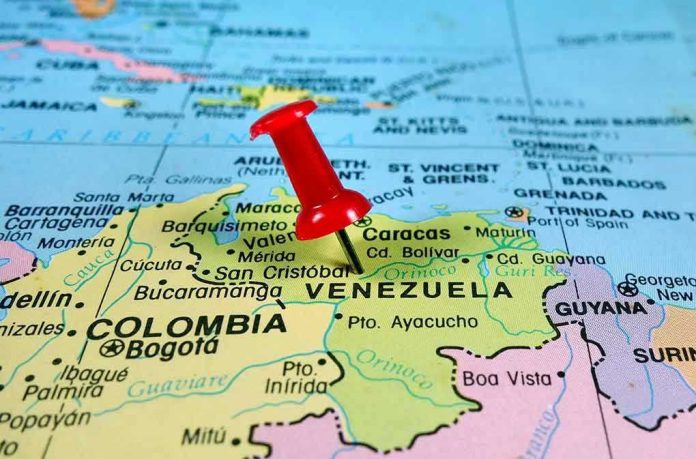
As Washington fights over Trump’s hard line on Venezuelan narco‑boats, conservatives are left asking whether Congress is guarding the Constitution or tying the hands of a president finally serious about stopping lethal drugs at the source.
Story Highlights
- Rand Paul joins Democrats warning Trump’s boat strikes could be a step toward war with Venezuela.
- Trump defends the operations as lawful, targeted blows against narco‑terrorists flooding America with drugs.
- The clash exposes a long‑running battle over who controls war powers: Congress or the commander in chief.
- Conservatives must balance support for Trump’s toughness with insistence on constitutional checks and limited war.
Rand Paul’s Warning About Mission Creep
Senator Rand Paul, a long‑time skeptic of foreign interventions, has broken with many in his party by warning that Trump’s lethal strikes on alleged Venezuelan drug‑smuggling boats risk becoming a prelude to a wider war or even an invasion of Venezuela. He argues that repeated maritime attacks, paired with forward‑deployed U.S. assets near Venezuelan waters, look less like isolated police‑style interdictions and more like the early phase of a military campaign that has never been explicitly authorized by Congress.
For constitutional conservatives, Paul’s alarm goes to the heart of separation of powers, not softness on crime or drugs. Past presidents from both parties have stretched war powers, conducting sustained military operations while Congress looked the other way. Many right‑leaning Americans watched endless interventions in the Middle East and feel burned by promises that limited strikes would not become full‑scale entanglements, fueling skepticism when any operation starts to resemble a slow‑motion slide into undeclared war.
Trump’s Case: Hitting Narco‑Terrorists Before They Hit Us
President Trump and his defense team frame the boat strikes very differently, presenting them as targeted, lawful actions against narco‑terrorists who help pump deadly cocaine and fentanyl precursors toward American communities. In their view, using U.S. military assets against fast boats in international waters is an aggressive form of border defense, meant to disrupt trafficking networks before their product crosses the Rio Grande, poisons families, and strains already fragile local resources in towns dealing with crime and addiction.
Officials lean on Article II commander‑in‑chief powers and existing counter‑drug statutes, arguing that as long as the targets are criminal networks rather than the Venezuelan state, new congressional authorization is not legally required. Supporters on the right see the policy as a welcome break from the old globalist posture that treated border security as optional and drug cartels as mere law‑enforcement problems. They credit Trump for finally matching tough rhetoric with real kinetic pressure on networks that have grown rich off American misery.
Legal Gray Zone and War‑Crimes Concerns
The controversy sharpened after reports of a particularly troubling incident in which a suspected drug boat was struck, survivors were left in the water, and a second strike allegedly killed those survivors, raising questions about possible violations of the laws of armed conflict. Critics contend that once individuals are incapacitated or clearly out of the fight, they should be treated as hors de combat, not legitimate targets, even if they were previously engaged in criminal or hostile activity. That line between combatant and noncombatant status sits at the center of the legal debate.
Military lawyers and international‑law scholars worry that calling traffickers “narco‑terrorists” and treating boat interdictions as quasi‑wartime actions erodes long‑standing norms that distinguish policing from armed conflict. If the United States normalizes lethal follow‑on strikes in ambiguous circumstances near another country’s waters, other powers could cite the precedent to justify their own cross‑border actions. That scenario alarms conservatives who favor strong borders and decisive action but also believe in clear rules of engagement and an American military that stays within both domestic and international law.
Congress’s Role and Conservative Skepticism of Endless Wars
Paul has joined some Democrats in pushing war‑powers resolutions that would bar an unauthorized war with Venezuela and force open debate on any move toward larger conflict. His stance reflects a long history of lawmakers warning that Congress has surrendered too much warmaking authority to the executive branch. For many conservatives who revere the Founders, the Constitution’s requirement that Congress declare war is not a technicality; it is a safeguard against presidents dragging the country into conflicts without the people’s consent.
Past episodes in Libya, Syria, Yemen, and elsewhere have shown how limited missions can grow into prolonged operations with little formal accountability. Grassroots Republicans who watched trillions spent overseas while Washington ignored border chaos and rising debt now expect their leaders to ask hard questions before green‑lighting another theater of potential conflict. That skepticism does not mean abandoning Trump; it means insisting that even a president they support must operate within clear constitutional guardrails when lives and national treasure are on the line.
Implications for U.S.–Venezuela Relations and Regional Stability
The Venezuelan regime, already under heavy U.S. sanctions and diplomatic isolation, portrays the boat strikes as proof that Washington seeks regime change and may be preparing an invasion. Caracas uses that narrative to justify tighter ties with Russia, China, and Iran while putting local forces on heightened alert. Each new U.S. operation near Venezuelan waters increases the chance of miscalculation or an incident involving state forces, which could suddenly escalate a counter‑drug campaign into a broader confrontation.
Rand Paul Warns That Trump's 'Boat Attacks Are a Prelude to an Invasion of Venezuela' https://t.co/W0msNyWL3D
— Mediaite (@Mediaite) December 4, 2025
Neighboring countries in the region worry about spillover if tensions boil over, even as many quietly support hitting trafficking networks that destabilize their own communities. Any sharp deterioration in Venezuela’s security or economy could also worsen migration pressures, pushing more people toward the U.S. border at a time when American taxpayers already feel overwhelmed by illegal immigration, social‑service burdens, and housing strains. That possibility reinforces why conservatives want policies that are tough on cartels yet carefully calibrated to avoid another open‑ended foreign commitment.
Sources:
Boat strike controversy tests Republican loyalty to Trump on war powers