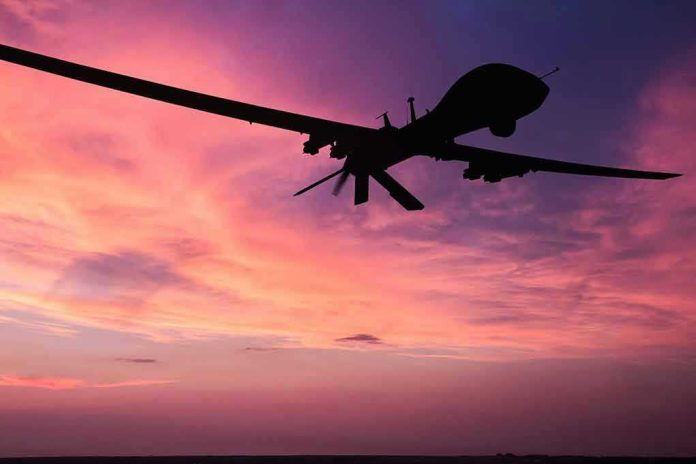
America’s military leaders now warn that battlefield drones, once dismissed as hobbyist toys, have become the most urgent security threat of our lifetime, challenging the nation’s defenses and testing our constitutional freedoms in ways few could have imagined just years ago.
Story Snapshot
- The U.S. Army Secretary calls drones a “threat of humanity’s lifetime,” citing battlefield lessons from Ukraine.
- New anti-drone task force (JIATF 401) launched to unify and accelerate America’s response.
- Tech industry CEOs and the Army are collaborating to develop real-time aerial monitoring and countermeasures.
- Balancing civil liberties with security is now a front-line issue as regulatory gaps persist.
Drone Warfare: From Hobbyist Toy to National Security Emergency
U.S. Army Secretary Dan Driscoll’s recent declaration—that drones are the “threat of humanity’s lifetime”—signals a seismic shift in how America must approach national defense. His warning, delivered during a high-profile interview, comes after years of watching Ukraine devastate Russian armored columns with swarms of cheap, commercially available drones.
These battlefield lessons have forced the U.S. military to confront the reality that adversaries, whether rogue states or terror groups, can now exploit off-the-shelf technology to bypass traditional defenses and inflict catastrophic harm at little cost.
The proliferation of drones underscores how previous administrations’ regulatory complacency and focus on globalist priorities left America vulnerable. While resources were diverted overseas and on social engineering, our own skies quietly became a new front line.
The rise of unmanned aerial systems (UAS) has democratized warfare, giving both state and non-state actors the ability to conduct surveillance, launch attacks, and disrupt critical infrastructure. Past attacks on oil facilities, airports, and military bases worldwide have demonstrated just how easily these tools can be turned against us, raising alarms about terrorism and sabotage right here at home.
America Responds: Task Force JIATF 401 and the Tech-Military Alliance
Recognizing the urgency, Secretary of Defense Pete Hegseth directed Driscoll to establish Joint Interagency Task Force 401 (JIATF 401) in August 2025. This task force replaces previous piecemeal efforts, consolidating military, intelligence, and industry resources for a unified counter-UAS strategy.
The Army is now working hand-in-hand with major technology CEOs to develop real-time, nationwide aerial monitoring networks and advanced AI-driven detection systems. The goal: to rapidly identify and neutralize drone threats before they can be used against American troops, infrastructure, or civilians.
This partnership marks a clear departure from the bloated, slow-moving bureaucracy that has plagued past defense initiatives, promising instead agile, common-sense solutions that put American security before political correctness or globalist distractions.
These rapid developments highlight a return to conservative principles: defending the homeland, prioritizing American innovation, and cutting through red tape.
The Trump administration’s willingness to empower military leaders, foster public-private partnerships, and demand accountability is a direct response to the failures of previous years, where bureaucracy and misplaced priorities often stifled action and wasted taxpayer dollars.
Regulatory Dilemmas: Liberty, Privacy, and the Need for Vigilance
As the military races to secure the skies, policymakers must confront the thorny balance between security and liberty. The urgent need for real-time aerial monitoring and rapid threat mitigation collides with core constitutional values—especially privacy and due process.
Lawmakers face mounting pressure to close regulatory gaps without overreaching or enabling government surveillance. Past failures to update legal frameworks have left America playing catch-up, as adversaries exploit regulatory gray zones and technology outpaces the law.
Congress must now act decisively to fund counter-drone initiatives, clarify rules of engagement, and ensure that innovation is not stifled by bureaucratic inertia. At the same time, robust oversight is needed to prevent mission creep and protect the rights of law-abiding citizens.
For conservatives, this is a defining moment: safeguarding the homeland must not come at the expense of constitutional freedoms. The challenge is to outpace our enemies while upholding the principles that make America exceptional.
New Threats, New Resolve: Lessons from Ukraine and the Road Ahead
Ukraine’s success in leveraging drones for asymmetric warfare serves as both a warning and a roadmap for U.S. adaptation. The cost-effectiveness and lethality of modern UAS have destroyed billions in enemy equipment, proving that innovation—not just firepower—wins wars.
America’s armed forces are reactivating specialized training, such as jungle warfare in Panama, to prepare for evolving threats across all environments. The formation of JIATF 401 and the deepening alliance with the tech sector demonstrate a renewed commitment to staying ahead of adversaries and protecting American lives.
The stakes could not be higher. Military experts, tech leaders, and policymakers agree: drones represent a rapidly escalating threat that demands urgent, coordinated action.
As the Trump administration leads with strength and clarity, Americans can be confident that conservative values—limited government, individual liberty, and a strong national defense—remain at the heart of our response to this new era of warfare.
Sources:
Army Secretary Drone Threats, Ukraine Innovation (azat.tv)
Hegseth Calls for Anti-Drone Task Force (army.mil)
Hegseth Directs U.S. Army to Form Anti-Drone Task Force (The Watch Journal)
Unleashing U.S. Military Drone Dominance (Department of Defense PDF)
Is America Prepared for a Widescale Drone Attack? (KABB Fox San Antonio)
Counter-UAS Legislative Developments (Congress.gov)