Federal agents stormed Manhattan’s Chinatown, arresting migrants and clashing with activists—fueling new outrage over law enforcement priorities and community safety under President Trump.
Story Snapshot
- ICE and DHS raided Chinatown street vendors, arresting nine migrants and four protesters.
- Protests erupted with hundreds blocking federal officers and chanting anti-ICE slogans.
- Trump’s administration continues tough enforcement, ending “sensitive locations” and prioritizing mass deportations.
- Local immigrant communities face heightened fear and economic disruption amid federal crackdowns.
Federal Immigration Enforcement Hits Chinatown Hard
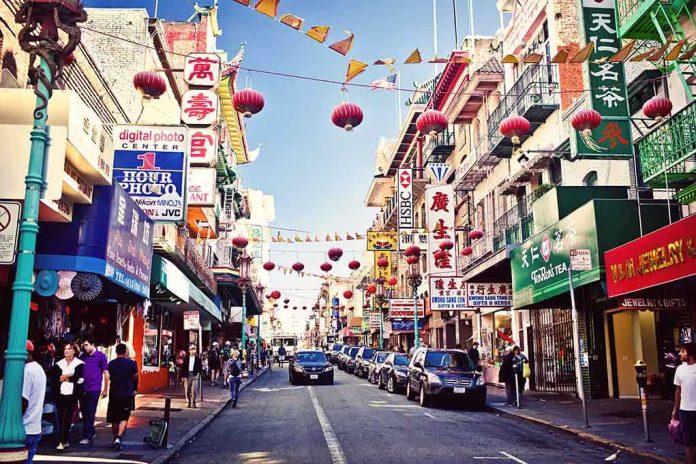
On October 21, 2025, ICE agents backed by DHS executed a large-scale raid in Manhattan’s Chinatown, targeting street vendors accused of selling counterfeit goods. The operation unfolded during peak hours, maximizing visibility in one of the city’s densest immigrant neighborhoods. Federal officers arrested nine migrants from West Africa on alleged immigration violations and detained four protesters who tried to obstruct law enforcement. This aggressive enforcement signals a new era of federal-local tension as Trump’s administration intensifies its crackdown on illegal immigration and informal economies.
Hundreds of bystanders and activists rapidly mobilized, surrounding federal agents and chanting “ICE out of New York!” The confrontation escalated into physical blockades, forcing officers to call for backup and extending the raid into the evening. Local advocacy organizations condemned the operation, citing excessive force and harm to vulnerable communities. The NYPD played a supporting role, managing crowds and attempting to de-escalate as Chinatown’s daily life ground to a halt. News coverage and social media amplified the chaos, driving public debate about the future of street vending and immigrant livelihoods under the current administration.
Trump Administration’s Intensified Immigration Policies
Since President Trump’s second inauguration in January 2025, his administration has aggressively reshaped immigration law and enforcement practices. Executive orders revoked previous protections, eliminated “sensitive locations” policies, and allowed ICE raids in public spaces like markets, schools, and churches. Trump’s appointment of Tom Homan as border czar signaled a renewed commitment to mass deportations, with federal agents empowered to detain and deport immigrants without traditional due process. The recent Chinatown raid reflects these priorities, with law enforcement leveraging expanded powers to target both counterfeit goods and immigration status in immigrant-heavy neighborhoods.
Major legislative actions, such as the Laken Riley Act, have mandated the detention of immigrants charged with certain crimes, while federal funding for enforcement has surged. The administration claims over 200,000 deportations since January, though independent estimates suggest lower numbers. Critics argue these policies create a climate of fear, disrupt families, and erode trust between communities and law enforcement. Supporters maintain that such actions are necessary to restore law and order and defend the integrity of American commerce and borders.
Local Resistance and Community Impact
Chinatown’s long history as a hub for immigrant entrepreneurship and street vending makes it especially vulnerable to federal crackdowns. Street vendors—many undocumented—rely on informal sales for economic survival, operating in legal gray zones. The raid disrupted livelihoods, instilling fear among residents and sparking citywide alerts as vendors in Brooklyn and beyond brace for similar enforcement. Advocacy groups and local politicians have condemned the raid, calling for reforms and protections for immigrant workers. Meanwhile, federal agencies emphasize the need to combat counterfeit goods and enforce immigration law, setting up ongoing clashes with sanctuary city policies and community resistance.
Short-term impacts include economic losses and heightened tensions, while long-term effects may include a chilling of street vending citywide and further polarization between federal authorities and immigrant communities. The debate over law enforcement priorities, constitutional rights, and the criminalization of poverty continues to intensify, with Chinatown’s experience serving as a flashpoint for broader national discussions.
Protests erupt as ICE agents raid NYC Chinatown street vendors allegedly selling counterfeit goods https://t.co/UfHMExKZWk #FoxNews
— Rob Beto Aragon🇺🇸🇮🇱🇻🇦 (@gopwillrise) October 22, 2025
Legal experts highlight unresolved questions about executive authority and due process, as courts begin to weigh in on the limits of federal enforcement. With ongoing protests and policy debates, the situation in Chinatown exemplifies the complex intersection of immigration, economic necessity, and American values. The Trump administration’s actions have drawn praise from those demanding stronger border protection and criticism from advocates defending immigrant rights and civil liberties. As raids expand and resistance grows, communities across the nation are watching closely, aware that the battle over enforcement and values is far from over.
Sources:
New York City ICE raid nets 9 arrests of illegal aliens from West Africa, 4 protesters also arrested
Immigrant Community Condemns Federal Immigration Raid in Chinatown
Federal agents descend on Chinatown in apparent raid
Brooklyn vendors on alert after ICE raid in Manhattan’s Chinatown