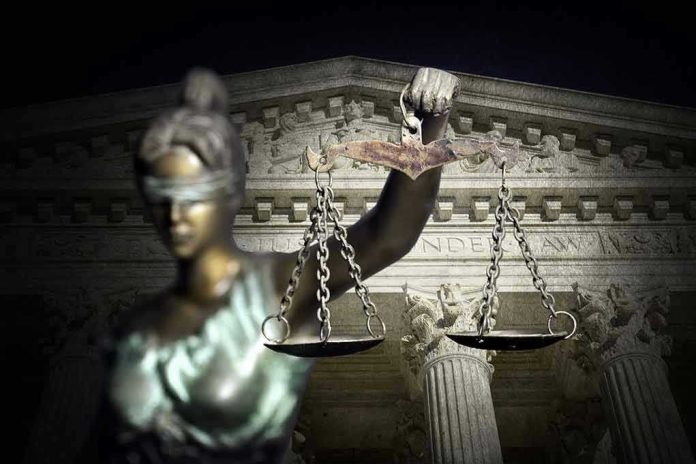
The Supreme Court’s latest case on Louisiana’s redistricting map could redefine the balance between the Voting Rights Act and the Constitution, with implications that might reshape national redistricting laws.
Story Highlights
- The Supreme Court is reviewing Louisiana’s 2024 congressional map, which includes two majority-Black districts.
- This case questions the balance between the Voting Rights Act and the Equal Protection Clause.
- The outcome could affect the 2026 midterm elections and minority representation.
- Reargument has been ordered, highlighting the case’s significance.
Supreme Court Faces Critical Decision on Redistricting
The U.S. Supreme Court is reviewing the legality of Louisiana’s 2024 congressional map, which proposes two majority-Black districts. This case, known as Louisiana v. Callais, tests the balance between the Voting Rights Act (VRA) and the Equal Protection Clause. The outcome is poised to have national implications for redistricting practices and minority representation, especially with the 2026 midterm elections on the horizon.
In 2022, Louisiana’s legislature passed a congressional map that included only one majority-Black district. Federal courts found this likely violated the VRA, as Black residents make up about one-third of the state’s population. In response, the state redrew the map in 2024 to include two majority-Black districts, complying with Section 2 of the VRA. The Supreme Court granted an emergency stay in May 2024, allowing elections to proceed under this new map.
Constitutional Challenges and National Implications
The case is pivotal in determining how far states can go in drawing districts that comply with the VRA without violating the Constitution. It questions whether the intentional creation of majority-minority districts is permissible. The Supreme Court’s decision to order a reargument indicates the exceptional significance of this case, which could reshape national redistricting law and the future application of the VRA.
With the 2026 midterm elections approaching, the case’s outcome will directly affect the political representation of Black voters in Louisiana. The decision will also set a precedent for how states consider race in redistricting, especially after recent Supreme Court rulings have narrowed the VRA’s application.
Implications for Minority Representation and Voting Rights
While civil rights groups argue that the remedial map is essential for fair representation, opponents claim it constitutes unconstitutional racial gerrymandering. This case echoes previous incidents like Robinson v. Landry and Allen v. Milligan, where courts upheld the need for additional majority-Black districts. Legal scholars caution that a ruling against the map could further erode the VRA, limiting remedies for racial vote dilution.
As the Supreme Court prepares for reargument on October 15, 2025, the stakes are high. The outcome could redefine the permissible use of race in redistricting across the nation and alter the enforcement of the VRA, impacting political representation and public trust in the electoral process.
Sources:
NAACP Legal Defense Fund, “Louisiana v. Callais – Legal Defense Fund”