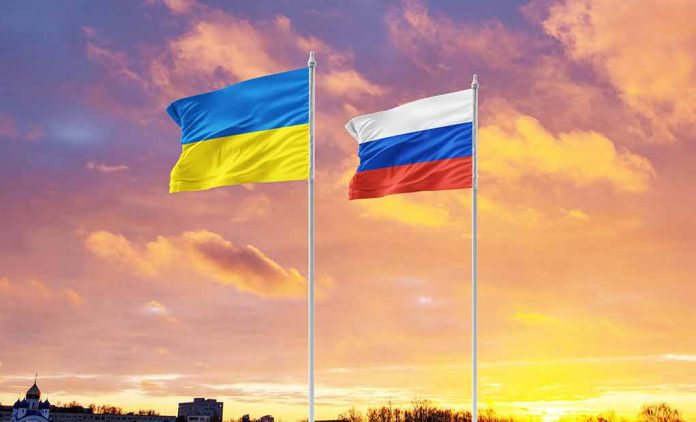
Russia threatens Ukraine’s survival if it attacks during Victory Day celebrations, as Putin’s three-day ceasefire offer clashes with Ukrainian demands for 30 days of peace.
Key Takeaways
- Russian official Dmitry Medvedev issued a stark warning that “Kyiv might not survive” if Ukraine attacks during May 9 Victory Day celebrations.
- President Trump proposed a permanent ceasefire plan recognizing Russian territorial claims, which Ukraine and Europe rejected as too conciliatory.
- Putin announced a short three-day ceasefire (May 8-10), while Ukraine countered with a 30-day proposal, creating a diplomatic deadlock.
- Russia has expanded its military presence along EU and NATO borders while allegedly expelling Ukrainian forces from Kursk with North Korean assistance.
- Recent Russian drone attacks on Kyiv have undermined peace negotiations, with Trump expressing dissatisfaction with the timing of these strikes.
Escalating Threats as Victory Day Approaches
The diplomatic temperature between Russia and Ukraine has reached a boiling point as May 9 approaches – a day Russia commemorates its victory in World War II. Dmitry Medvedev, deputy chairman of Russia’s Security Council, delivered an ominous warning to Ukraine, suggesting that Kyiv’s existence could be at stake if it attempts to disrupt Victory Day celebrations. The timing of these threats coincides with competing ceasefire proposals that have highlighted the vast diplomatic gulf between the warring nations.
“Zelenskyy understands that in the event of a real provocation on Victory Day, nobody will be able to guarantee that Kyiv will live to see May 10,” said Dmitry Medvedev, deputy chairman of Russia’s Security Council.
Ukrainian President Volodymyr Zelenskyy has firmly rejected providing any security guarantees for foreign dignitaries attending Moscow’s Victory Day events. His refusal comes as Russia has intensified its drone attacks on Kyiv, causing fires in residential areas and further undermining any possibility of a ceasefire agreement. The attacks have occurred despite ongoing peace negotiations, leading many Western observers to question Russia’s commitment to diplomatic solutions.
Competing Ceasefire Proposals Reveal Deep Divisions
President Vladimir Putin proposed a unilateral three-day ceasefire spanning May 8-10 to accommodate Victory Day celebrations in Moscow. This limited offer starkly contrasts with Ukraine and European demands for a more substantial 30-day cessation of hostilities. Zelenskyy dismissed Putin’s short-term truce as merely a theatrical show designed for propaganda purposes rather than a genuine step toward peace. The competing proposals exemplify the fundamental disconnect between Russian and Ukrainian perspectives on resolving the conflict.
“We cannot be responsible for what happens on the territory of the Russian Federation. They are responsible for your security, and therefore, we will not give you any guarantees,” said Ukrainian President Volodymyr Zelenskyy.
President Trump’s administration had previously put forward a permanent ceasefire plan on April 17 that recognized Russian ownership of Crimea and parts of four Ukrainian oblasts. The proposal also conceded to Russian demands that Ukraine should never join NATO and called for immediate lifting of sanctions against Moscow. European leaders and Ukraine swiftly rejected this plan as excessively favorable to Russia, proposing their own alternative that deferred territorial negotiations and maintained Ukraine’s right to determine its security alliances.
Trump’s Diplomatic Balancing Act
President Trump has expressed growing frustration with Russia’s actions, particularly following recent strikes on Kyiv. After meeting with Zelenskyy in Rome, Trump signaled that his patience with Putin was wearing thin, hinting at the possibility of renewed sanctions against Russia. This stance represents a notable shift in Trump’s approach, which had previously focused on finding a quick resolution to the conflict, even if it required significant Ukrainian concessions.
“I am not happy with the Russian strikes on Kyiv. Not necessary, and very bad timing,” said Donald Trump.
European leaders have pushed for a tougher stance against Russia. Czech President Petr Pavel emphasized that Putin alone holds the power to end the conflict, while Estonian Prime Minister Kaja Kallas has been particularly vocal in her criticism of Russia’s negotiating tactics. The European position generally favors maintaining pressure on Russia while providing Ukraine with the necessary support to defend its sovereignty and territorial integrity.
Military Developments Cast Shadow Over Negotiations
Russia claims to have successfully expelled Ukrainian forces from the Kursk region with assistance from North Korean troops – the first official acknowledgment of direct North Korean military involvement in the conflict. Additionally, Russia has reportedly expanded its military presence along its borders with EU and NATO countries, particularly near Finland. These developments have raised concerns about potential escalation beyond Ukraine’s borders and the formation of a more comprehensive anti-Western alliance.
“If you want the killing to stop, you should put the pressure on Russia, who actually does the killing,” said Kaja Kallas.
Meanwhile, intense fighting continues in eastern Ukraine, particularly around Pokrovsk in the Donetsk region. The battlefield situation remains fluid, with both sides seeking tactical advantages that could strengthen their respective negotiating positions. Putin has publicly downplayed the potential use of nuclear weapons in Ukraine while expressing hope for eventual reconciliation between the nations – statements that contrast sharply with Medvedev’s threatening rhetoric about Kyiv’s survival.